About the game
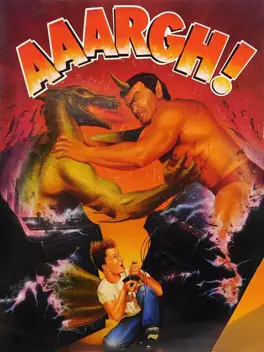
Aaargh! is a single-player action video game in which the player controls a giant monster with the goal of obtaining eggs by destroying buildings in different cities across a lost island. It was designed for Mastertronic's Arcadia Systems, an arcade machine based on the custom hardware of the Amiga, and was released in 1987. It was ported to a range of other platforms and released on these across 1988 and 1989. Electronic Arts distributed the Amiga version of the game.
From the Wikipedia article Aaargh!, by its contributors, under CC BY-SA 4.0.
Publisher
Krome Studios Melbourne Publisher
Former video game development studio
Based in Melbourne · founded 1977 · 16 other games here
Arcadia Systems, Inc. Publisher
0 other games here
Platforms and release dates
| Platform | Released |
|---|---|
| ZX Spectrum | – |
| Commodore 64 | – |
| Commodore Amiga | – |
| DOS | – |
| Amstrad CPC | 1988 |
| Atari ST | – |
| MSX | – |
| Apple IIGS | – |
| Arcadia Systems | 1987 |
| Classic Mac OS | – |
PC system requirements
Not added yet.
Details
| Genre | action game |
|---|---|
| Modes | single-player video game, co-op mode |
| Country | United States |
What critics say
Is Aaargh! worth playing?
One critic scored Aaargh! 60 out of 100. That makes its GameRaven score 6.1 out of 10. See every critic score.
Critic scores by outlet
| Outlet | Score | Out of 100 | Version | Date |
|---|---|---|---|---|
| Gen4 | 68% | 68 | Commodore Amiga | – |
| Gen4 | 53% | 53 | Atari ST | – |
Scores as recorded on Wikidata, with the outlet's own link where Wikidata cites one. User ratings are not listed.
No community posts about Aaargh! yet. Write the first: a guide, an analysis or an opinion piece. Your post gets a page of its own.
Community clips
See allCommunity images
See allNo community reviews yet. Be the first to review Aaargh!: a score out of 10, what works, what doesn't.
How the score works
6.1GameRaven score = Critics 100%
- Critics6.1100%
- Community–0%
The GameRaven score of 6.1 is the critics' average, from 1 critic, until members review the game. Community reviews and votes join it as they come in, each counting for more as more people stand behind it. How it's worked out.
Sources
- Facts and critic scores: Wikidata item Q88519 (CC0), read November 12, 2026. Spotted something wrong? It can be corrected on Wikidata, and the change reaches this page the next time the catalogue is read.
- Summary: Wikipedia, CC BY-SA 4.0.
- Cover art: IGDB.
- How the score is worked out: methodology.