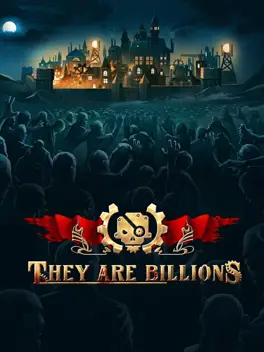
Where to buy They Are Billions
- Steam View store
- GOG View store
- Microsoft Store View store
- PlayStation Store View store
- Humble Store View store
- Amazon View store
Amazon links are affiliate links: as an Amazon Associate we earn from qualifying purchases.
About the game
They Are Billions is a post-apocalyptic steampunk real-time strategy survival video game developed and published by Numantian Games. Available on Microsoft Windows, it was released onto Steam's Early Access program with a survival mode in December 2017. The game was released with a campaign titled "New Empire" on June 18, 2019. PlayStation 4 and Xbox One versions were published by BlitWorks on July 1, 2019.
From the Wikipedia article They Are Billions, by its contributors, under CC BY-SA 4.0.
Developer and publisher
Larian Studios Spain Publisher
Spanish video game developer company
Based in Barcelona · founded 2012 · 7 other games here
Train Valley: Console Edition, Spelunky 2, Pirates Outlaws, Slipstream · all 8
Platforms and release dates
| Platforms | Microsoft Windows, PlayStation 4, Xbox One |
|---|---|
| Released | December 13, 2017 |
PC system requirements
Not added yet.
Details
| Genre | real-time strategy, survival game |
|---|---|
| Modes | single-player video game |
| Sold on | Steam, GOG.com, Microsoft Store, PlayStation Store, Humble Store |
| Country | Spain |
| Official site | numantiangames.com |
What critics say
They Are Billions rewards careful planners, but critics never fully lined up
A steampunk zombie siege that critics rated solidly, if not uniformly, and that punishes one gap in a wall harder than most strategy games do.
Is They Are Billions worth it?
They Are Billions is a focused base-defense game. One weak spot in your layout can turn into a spreading outbreak. Its critic averages run from 71/100 to 77/100, and its critic average is 7.3. Critics liked it more than they championed it, and the design explains why: it asks for patience and planning, and it doesn't forgive much. If you enjoy building a defense more than winning a firefight, play it.
Best for: For patient strategy players who like designing a defense and adjusting it under pressure, and who don't mind losing a run to one weak wall.
Written from the published record (critics' reviews, the developer's documentation and the game's history), not a hands-on playthrough. How these are written.
What critics praised
- Pausing at any time lets you plan without racing the clock[1]
- Hordes arrive at set times, so you can prepare for each one[1]
- Eight resources and a tech tree give each base real tradeoffs[1]
- Varied zombie types like Harpies, Chubbies and the Infected Giant force you to change tactics[1]
- A full campaign, "New Empire," added on top of survival mode[1]
Critic scores by outlet
| Outlet | Score | Out of 100 | Version | Date |
|---|---|---|---|---|
| CriticDB aggregate of 9 | 71/100 | 71 | Xbox One, PlayStation 4, Microsoft Windows | – |
| OpenCritic aggregate of 44 | 75/100 | 75 | – | May 1, 2020 |
OpenCritic: 49% of critics recommend it.
Scores as recorded on Wikidata, with the outlet's own link where Wikidata cites one. User ratings are not listed.
- AnalysisThey Are Billions rewards careful planners, but critics never fully lined up
Critics disagreed most about how strongly to back They Are Billions. One tally of 44 reviews, recorded on May 1, 2020, gave it an average of 75/100. The same tally also posted a figure of just 49%. A…
Community clips
See allCommunity images
See allNo community reviews yet. Be the first to review They Are Billions: a score out of 10, what works, what doesn't.
How the score works
7.3GameRaven score = Critics 100%
- Critics7.3100%
- Community–0%
The GameRaven score of 7.3 is the critics' average, from critic aggregates, until members review the game. Community reviews and votes join it as they come in, each counting for more as more people stand behind it. How it's worked out.
Sources
References
- Wikipedia: They Are Billions en.wikipedia.org
Where the rest comes from
- Facts and critic scores: Wikidata item Q47206077 (CC0), read November 12, 2026. Spotted something wrong? It can be corrected on Wikidata, and the change reaches this page the next time the catalogue is read.
- Summary: Wikipedia, CC BY-SA 4.0.
- Cover art: IGDB.
- Critics' overview written from: Wikipedia: They Are Billions, CC BY-SA 4.0.
- Critics' overview written from: Wikidata: Q47206077, CC0.
- How the score is worked out: methodology.